SIAMES FIGHTING FISH...
Siamese fighting fish
| Siamese fighting fish | |
|---|---|
 | |
| Halfmoon male | |
Scientific classification | |
| Domain: | Eukaryota |
| Kingdom: | Animalia |
| Phylum: | Chordata |
| Class: | Actinopterygii |
| Order: | Anabantiformes |
| Family: | Osphronemidae |
| Genus: | Betta |
| Species: | B. splendens |
| Binomial name | |
| Betta splendens Regan, 1910 | |
The Siamese fighting fish (Betta splendens), commonly known as the betta, is a freshwater fish native to Southeast Asia, namely Cambodia, Laos, Myanmar, Malaysia, Indonesia, Thailand, and Vietnam. It is one of 76 species of the genus Betta, but the only one eponymously called "betta", owing to its global popularity as a pet; Betta splendens are among the most popular aquarium fish in the world, due to their diverse and colorful morphology and relatively low maintenance.
Betta fish are endemic to the central plain of Thailand, where they were first domesticated at least 1,000 years ago, among the longest of any fish. They were initially bred for aggression and subject to gambling matches akin to cockfighting. Bettas became known outside Thailand through King Rama III (1788–1851), who is said to have given some to Theodore Cantor, a Danish physician, zoologist, and botanist. They first appeared in the West in the late 19th century, and within decades became popular as ornamental fish. B. splendens long history of selective breeding has produced a wide variety of coloration and finnage, earning it the moniker, "designer fish of the aquatic world".
Bettas are well known for being highly territorial, with males prone to attacking each other if housed in the same tank; without a means of escape, this will usually result in the death of one or both fish. Female bettas can also become territorial towards one another in confined spaces. Bettas are exceptionally tolerant of low oxygen levels and poor water quality, owing to their special labyrinth organ, a characteristic unique to the suborder Anabantoidei that allows for the intake of surface air.
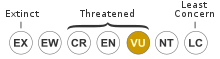
In addition to its worldwide popularity, the Siamese fighting fish is the national aquatic animal of Thailand, which remains the primary breeder and exporter of bettas for the global aquarium market. Despite their abundance as pets, B. splendens is listed as "vulnerable" by the IUCN, due to increasing pollution and habit destruction Efforts are being made to support betta fish breeders in Thailand as a result of their popularity as pets, cultural significance, and need for conservation
Etymology
Outside Southeast Asia, the name "betta" is used specifically to describe B. splendens, despite the term scientifically applying to the entire genus, which includes B. splendens and at least 72 other species. Betta splendens is more accurately called by its scitific name or "Siamese fighting fish" to avoid confusion with the other members of the genus.
English-speakers often pronounce betta as "bay-tuh", after the second letter in the Greek alphabet. However, it is believed the name is derived from the malay word ikan betta, with ikan meaning "fish" and bettah referring to an ancient warrior tribe, which is pronounced "bet-tah". Alternative sources suggests the name Betta splendens is formed from two languages, consisting of Malay for "enduring fish" and the Latin word for shining.
Another vernacular name for Siamese fighting fish is plakat, often applied to the short-finned ornamental strains, which is derived from the Thai word pla kat (Thai: ปลากัด), which literally means "biting fish". This name is used in Thailand for all members of the Betta genus, which share similar aggressive tendencies, rather than for any specific strain of the Siamese fighting fish. Thus, the term "fighting fish" is used to generalise all Betta species besides the Siamese fighting fish.
Siamese fighting fish were originally given the scientific name Macropodus pugnax in 1849—literally "aggressive fish with big feet", likely in reference to their elongated pelvic fins. In 1897 they were identified with the genus Betta and became known as Betta pugnax, referring to their aggressiveness. In 1909, the species was finally renamed Betta splendens upon the discovery that an existing species was already named pugnax.
Description
B. splendens usually grows to a length of about 6–8 cm (2.4–3.1 in). Although aquarium specimens are widely known for their brilliant colours and large, flowing fins, the natural coloration of B. splendens is generally green, brown and grey, while the fins are short; wild fish exhibit strong colours only when agitated. In captivity, Siamese fighting fish have been selectively bred to display a vibrant array of colours and tail types.

Comments
Post a Comment